
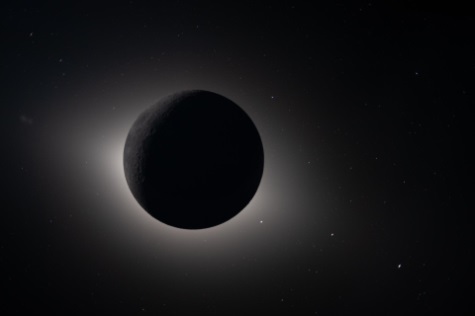
Photo courtesy of NASA/Orion Crew
Artemis II
Circles Moon,
Sets Records
| published April 7, 2026 |
By R. Alan Clanton
Thursday Review editor
The astronauts of the Artemis II mission have travelled father from the Earth than any other humans. On Monday, April 6 and Tuesday, April 7, the Orion spaceship and its crew of four astronauts rounded the moon, breaking a record previously set by the crew of Apollo 13 in 1970.
The Orion spaceship made its slingshot circle of the moon at a distance of a little over 4,060 miles (6,545 km) above the surface at its closest point, and an astounding 252,756 miles from Earth. For forty minutes the NASA astronauts lost all contact with Earth, but regained it on schedule at 7:24 p.m. Eastern Time. Late Monday night, President Donald Trump spoke with the crew, and called them "modern-day pioneers.”
The crew also sent back to Earth astounding high quality photos of the moon, Earth, and the sun, including an “Earthset” photo showing a partial Earth settling behind the rim of the moon, and numerous high resolution photos of a solar eclipse as the Orion spacecraft rounded the moon with the Sun behind it. The eclipse lasted about one hour.
During the eclipse period, the crew observed at least six significant impact crashes—seen from their vantage point as sharp flashes—caused by meteors striking the surface of the moon. The crew’s flyby of the moon lasted about seven hours.
The Artemis II rocket launched from the John F. Kennedy Space Center last week, beginning the mission of sending humans to the moon for the first time since the end of the Apollo missions. Though the NASA had no plans on this mission for the astronauts to land on the moon, the Artemis II system and Orion spacecraft are being tested fully for future missions. If all goes well, NASA hopes to have humans step again onto the moon as soon as mid-2028, setting the stage for future long-distance missions to Mars.
The astronauts will return to Earth on Friday evening, splashing down in the Pacific Ocean at a point between 50 and 250 miles southwest of San Diego, where the USS John Murtha will await to assist in the recovery of crew and spacecraft. The exact point of the splashdown will be based on weather conditions in the hours before reentry.
Among the surprises for both astronauts and NASA: the striking detail and illumination available to the naked eye as the moon completely obscured the sun and the astronauts looked down at a relatively dark lunar surface. This, too, greatly enhanced the quality of the photographs taken with the astronaut’s digital cameras.
The crew’s science missions included monitoring and measuring color variances on the lunar surface, documenting impact craters, and photographing surface features such as fractures and canyons. In addition to the geological knowledge, these detailed observations will help scientists and engineers better understand the moon’s surface ahead of plans to build permanent structures on the lunar surface.
Aboard the Orion spaceship are four astronauts: Reid Wiseman (commander), Victor Glover (pilot), Christina Koch (mission specialist), and Jeremy Hansen (mission specialist). Artemis II includes several firsts for NASA crews: Glover is the first African-American to travel to the moon; Koch is the first woman to travel to the moon; Hansen is the first Canadian (and the first non-American) to travel to the moon.
Related Thursday Review articles:
Orion is Older Than You Think; R. Alan Clanton; Thursday Review; December 9, 2014.
Space Station View: The Nile at Night; By Thursday Review staff; October 5, 2015.