
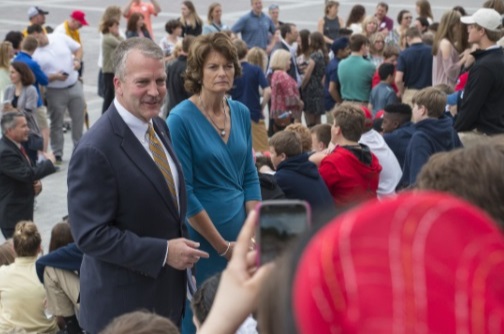
Photo courtesy Dan Sullivan
Alaska's Senate Race Conundrum
| published October 28, 2026 |
By R. Alan Clanton,
Thursday Review editor
In the imaginations of many Americans, things can get very cold in Alaska. But this week—with only days left before a spate of midterm elections across the nation decides the balance of power in Washington—things have heated up in Alaska, and the political environment may get hotter.
For much of the year, the extremely tight race between incumbent U.S. Senator Dan S. Sullivan and his Democratic challenger Mary Peltola has had as its shadow the quirky presence of a fully-qualified candidate by the name of Dan J. Sullivan, a retired schoolteacher from a small Alaska town. Dan J. Sullivan, a registered Republican, is running as an independent.
GOP leaders in Alaska have worried openly that this may cause significant enough confusion on Election Day to tip a very close race into a Peltola victory. Indeed, in race where the two candidates are less than three percentage points apart in recent polling, an “accidental” drift of even 4 percent could spell defeat for the incumbent, Dan Sullivan.
Polls have shown the Alaska Senate race is one of the eight razor close Senate races across the country. Similarly narrow contests are happening in Kansas, Michigan, Iowa, Ohio, Texas, and Maine. Some of these races are so tight, and the stakes are so high, that President Trump has altered his schedule to intervene with appearances, and former President Barack Obama has campaigned in at least two of the most critical—Michigan and Ohio.
But the fracas in Alaska is now unlike any of the other races.
Only days ago, Trump and the White House weighed-in with a recommendation—exceedingly controversial and perhaps unprecedented—to insist that Alaska’s senate election be invalidated if the incumbent Dan Sullivan does not win.
Throughout the spring and summer, the Peltola campaign has insisted it had neither control over—nor any role in planning—the campaign of Dan J. Sullivan, the downticket “imposter” Sullivan. And Dan J. Sullivan, the retired teacher, has repeatedly told interviewers and the media that he has had no official contact with the Peltola team. Since it is not illegal under either Federal or Alaska law to appear as a candidate on a ballot with a similar or identical name, most reporters and media simply reported the oddity.
But for Republican incumbent Dan S. Sullivan, the danger has been simmering, and now that the race has tightened like so many others around the country, there is the very real possibility that a very small percentage of confused voters in, for examples, Badger, or in Wasilla, or in Ketchikan, may alter the balance of power in the United States Senate by voting for the “other” Dan Sullivan.
Trump’s insistence that the FBI and the Justice Department investigate, and that the results of the election be tossed out—assuming that things go badly for Dan Sullivan, the incumbent—drew widespread criticism from many Democrats and sparked scorn on the part of much of the media. The basic question was this: is it constitutionally legitimate to invalidate a Senate election simply because two candidates have the same name?
It remains unclear that the White House or President Trump would have had that authority, even using the various departments and bureaus as leverage. And there are almost never do-overs when it comes to general elections.
But now, based on an investigation by the New York Times, it turns out that Democrat Peltola knew that the phony Dan Sullivan was in fact solicited by her own team to get his name on the ballot. Dan J. Sullivan would have been required to obtain the minimum number of signatures (I researched this, but the exact number of signatures required is vague or not available, even using the official Alaska elections website) by the June deadline. Apparently the downticket Sullivan was able to easily accomplish this task.
The New York Times article suggests that the Peltola campaign actively sought to locate a “Dan Sullivan” who would agree to become a shill candidate, and the Peltola campaign may have contacted hundreds of Dan Sullivans across the state of Alaska in that recruitment effort. More disturbing, it means that Peltola and her staff lied to reporters and to the media when asked (repeatedly) if they were behind the candidacy of the second Dan Sullivan.
President Trump is now telling reporters that the results of the Alaska Senate race will be unreliable in the extreme. He has said Peltola should immediately drop of the of the race, and he has upped the ante by demanding that Peltola—and the others on her team who were involved in the scheme—be prosecuted.
As of this week, the Alaska Division of Elections revealed the four names on the ballot for the U.S. Senate seat: Peltola, the two Dan Sullivans, and yet another Republican, Gerald Heikes, whose appearance on the ballot came after an alternate Democratic candidate, David Leslie, dropped out the previous week. Under Alaska election rules, only the four top vote-getters from the previous rounds of primaries can be on the general election ballot in November.
Despite the deluge of phone calls by reporters to the Peltola campaign, Peltola’s staff and team offered little explanation (and no denials) for the skullduggery. Dan J. Sullivan still insists he is simply running for office of his own accord, and still maintains he has had no direct contact with the Peltola campaign. The veracity of this may be tested however if Trump makes good on his threat of legal actions and prosecution.
Dan J. Sullivan’s candidacy was already challenger earlier in the year by Senator Sullivan, and by the GOP. Initially the Division of Elections agreed to scratch the “second” Dan Sullivan from the ballot, but after the legal fracas made its way to the Alaska Supreme Court, the justices ruled that Dan J. Sullivan could stay on the ballot. Almost immediately, authorities in Alaska launched a state investigation into whether there was any coordination between the Peltola campaign and the retired school teacher.
Then, on Wednesday, Alaska Governor Mike Dunleavy ordered a full and expansive investigation into the matter regardless of the Division of Elections probes and the other investigations. Dunleavy said that the Department of Public Safety would immediately explore the possibility that Alaska laws had been broken and that criminal charges or civil charges will be filed.
Still, some legal experts say there are scant few laws in the United States to prevent this sort of situation, and it would not be the first time that a campaign 1) actively sought to recruit and enable a spoiler candidacy, and 2) found that the best weapon in the effort was another candidate with a similar or confusingly identical name. (I’m old enough to recall a time when in a single year, there were three Jim Smiths running for elected office at the state level in Florida).
Since those revelations that the Peltola campaign conspired to identify a willing spoiler, the candidate has said little except to indicate at a few campaign stops that the fracas is merely a distraction from the core issues of inflation and the cost of living. She has not directly responded to reporters since the storm began.
The Alaska Senate seat is one of several potential wins for Democrats, who hope to regain control of the Senate in the midterm election. Though typically candidates supportive of Trump, or supported by Trump, can consider their prospects good, this year’s elections have uniformly become a widespread referendum on the economy, wages, food and gas prices, and the war in Iran. That has largely loosened the alliance between the President and his favored candidates. And it has put the GOP at risk of losing its numerical advantages in the U.S. House and the U.S. Senate.
Related Thursday Review articles:
Georgia Senate Race Could Define Future Presidential Stakes; By R. Alan Clanton, Thursday Review editor; October 25, 2026.
Alaska Senate Race Has Become a Critical Contest; By R. Alan Clanton, Thursday Review editor; August 20, 2026.