
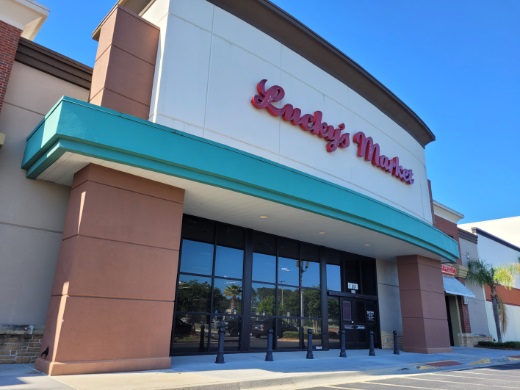
Photo by R. Alan Clanton, Thursday Review
Did the Sunshine State
Kill Lucky's Market?
| published May 3, 2026 |
By R. Alan Clanton, Thursday Review editor
There are two narratives here. The first is that when it comes to grocery stores and food markets, Florida is the land opportunity—a place of near-continuous growth and a constant flow of people from all other parts of the country. The second is that Florida is a killer of grocery stores—a sausage machine that grinds up retailers, begets fierce, insane forms of competition, and forces stores to close.
It appears both narratives are true. It just depends on who is telling the story.
In Florida, Winn-Dixie’s recent partnerships with Amazon appear to be serving both companies well. Instead of the “experiment” it appeared to be only last year, the strategic alliance is being readily expanded. For the moment, Winn-Dixie’s fortunes appear on the rise, so much so that city leaders in its 80-year hometown of Jacksonville instantly agreed to all the financial incentives—some $6.2 million in total—to cajole Winn-Dixie to keep it headquarters where it’s been for decades.
Kroger, meanwhile, unceremoniously pulled-up its stakes and abandoned all hope in the Sunshine State. In February, the Cincinnati-based Kroger ended its grocery deliver service in the state, shutting down its massive distribution and storage facility in Lake County, and closing down smaller fulfilment hubs in Tampa, Jacksonville, and Cocoa Beach. Kroger also appears to be decelerating its plans to build Harris Teeter retail stores in Florida, a chain it has owned since 2013.
Simultaneously, the German-based Aldi, which bought most of the Winn-Dixie footprint and has already converted some Winn-Dixie locations into Aldi-branded stores, has recently surpassed Kroger as the nation’s largest grocery retailer. Aldi too has eyes on Florida as it enters into an ambitious plan to add some 180 stores nationally in 2026 and still more next year.
Florida-based Publix remains the favorite across the Sunshine State—with more stores and greater customer loyalty—but its once-sturdy and envied position on Newsweek’s annual survey of businesses as the number one most trusted grocery store has eroded, slightly. Publix is now ranked fourth nationally (though it remains top dog in Florida) and operates stores in eight southeastern states. Only weeks ago, Publix opened a new 42,000 square foot store in Durham, North Carolina.
The glittery appeal of Florida once lured the Colorado-based Lucky’s Market into the Sunshine State.
Way back in 2002, when produce sellers Bo and Trish Sharon took their Boulder, Colorado area market and turned it into a “regular” store, branding it Lucky’s Market, they simply wanted to create a casual farmer’s market feel environment, with most items in wooden crates or atop sturdy cardboard boxes. The two owners had little idea that Florida would ever factor into their seemingly modest approach to the grocery business.
The Sharon’s founded their enterprise in the heart of the growing organic food subculture, in Boulder, a college and technology town which encapsulated the complex relationship customers have with “organic”: a hip, food-savvy buying base predisposed to all things healthy and all things ruggedly natural, but simultaneously askance at organic’s notably high pricing. So Lucky’s sought to bridge this gap, relentlessly looking for ways to reduce overhead, tracking labor costs closely, and still offering a robust combination of organic and healthy items along with plenty of traditional packaged products.
To combat the longstanding image of purely organic markets as expensive food boutiques, Lucky’s fused the organic model with the traditional model to create a hybrid grocery store. Their oft-cited slogan was “organic for the 99%,” meaning—for those potential customer who missed the point—Lucky’s was affordable. This arrangement worked out particularly well in college towns, where students often lived on sparse budgets, but still wanted their share of “healthy.” Many of these younger buyers were unable to afford what they browsed in Whole Foods or Fresh Markets.
The formula worked. Lucky’s quickly developed a loyal following, and the small chain steadily expanded alongside the rapidly evolving interest in organic foods and healthy foods, and an even greater demand for any grocery store not fixated on competing only with Walmart, whose grocery store expansions were hitting full stride. Within about 10 years, Lucky’s had grown to roughly 20 locations scattered about the Rocky Mountain States and the Midwest.
Then, in 2016, grocery giant Kroger stepped in and offered to take Lucky’s big league. Kroger bought the majority stake in Lucky’s, and both companies had optimistic plans for how this new merger would work out; Lucky’s would surely expand more rapidly, with enough cash in hand to open new stores in new states; Kroger would have its hands firmly in place in what had been—up to that point—the niche market of organic and natural foods. Both companies hoped also that they could readily incorporate the best from each business model, and Lucky’s would have a senior partner with both more buying power and substantial vertical integration.
But Kroger had bigger fish to fry. The Ohio-based Kroger was already on track to be the nation’s largest grocery retailer, with its eye firmly on Florida, where Publix had remained dominant for years. Publix was expanding in tandem with state’s robust population growth, and the Lakeland-based company was adept at picking the right locations as Florida’s suburban sprawl marched outward. In addition, Publix had (and retains now) a famously loyal customer base—shoppers closely attuned to the chain’s buy-one-get-one offers on staple items, and highly comfortable with the Publix offerings in its produce departments (something Publix has fine-tuned through effectively partnering with many Florida growers).
Plus, Publix was gaining traction in Florida even as Winn-Dixie continued to struggle in its battle to retain some of the same shoppers who were migrating to Walmart for savings.
Kroger wanted in on this action, and nudged its junior partner Lucky’s into a building campaign in the Sunshine State in an effort to outflank Publix on its “organics” products, while also offering something brighter and more eye-catching than what some shoppers might find in either Winn-Dixie or Walmart. But other grocery retailers were also moving in Florida at a substantial clip, including two of the best known—Whole Foods and Fresh Markets, though neither chain is known for its competitive pricing. And that’s what both Kroger and Lucky’s were hoping to exploit. Lucky’s opened a half dozen new retail stores in Florida, with ambitious plans to open more. One of the company's goals was to open as many as 50 retail stores in Florida by 2023, about as ambitious a plan as one could conceive. Lucky’s opened its first Sunshine State store in the college town of Gainesville in 2015, and other locations shortly thereafter in Tallahassee, Naples, and Orlando (including a 34,500 square foot store in Neptune Beach).
The goal was to seize, early on, health-conscious and organics-conscious (often younger family) shoppers before they found their way into the nearest Publix, luring them with the sort of prices that would forever keep them from hanging around Whole Foods, Fresh Market, or Sprouts for very long. And like Publix, Lucky’s hoped to seize key sites in rapidly expanding areas, where younger but upwardly-mobile families might put down roots.
But that niche in Florida may have proved too narrow, or too complex, or geographically too diffuse. Location is king, and in a state like Florida it can be maddeningly complex to find a site for a store without bumping headlong into seniors, or going shoulder-to-shoulder with Winn-Dixie, Walmart, or Publix, whose middle-class customers and family shoppers have already established firm buying patterns.
Example: when a brand new Lucky’s opened only about 2 miles from my house in 2017, my wife and I went in for a browse. Customers could buy beer or wine by the glass and shop, there were deli counters and prepared foods kiosks operating full-tilt, and some departments offered samples of the foods and snacks—cheese, crackers, cookies, etc. The store’s staff was exceedingly friendly, and because it was a slow night (or seemed that way to us), all employees went out of their way to make us feel welcome. The vibe was as good as it could get.
But, counter-intuitively, this was itself a strange sign. The store seemed wildly overstaffed for the floor space and the light foot traffic, despite its seemingly ideal location between a large multi-screen movie theater and a full-service gym. The produce was indeed affordable and the products looked good, and the traditional grocery items were priced reasonably. But here too was another rub: this Florida Lucky’s retail store was less than one half mile from both a Publix and a Target grocery store, and only two miles from a Winn-Dixie (interestingly, Aldi would open a grocery store across the street from that Publix only a year or two later). I found little incentive to buy a box of cereal which was only 4 cents cheaper than Publix, or the package of pasta 5 cents costlier than the same box at Target.
In short, the Lucky’s we visited that night was both labor-intensive in every respect, and seemingly too close for geographic comfort to the large Publix and the even larger Target. Some Florida newspapers reported as new stores opened: The Florida Times Union said that the Neptune Beach store would employ 145 people; the Tallahassee location employed 160. For both locations, this seemed to suggest a heavy labor cost when compared to the traffic, the floor space, and the product offerings.
Some grocery business analysts have also pointed to another obvious problem: Lucky’s may have arrived in Florida at precisely the wrong moment—or, to paraphrase comedian George Carlin, 15 minutes late. Florida was effectively swept under the tsunami of health food and organic type stores beginning in the middle teen years, and these retail brands included not just the aforementioned Whole Foods and Fresh Markets, but also Sprouts, Earth Fare, and the beginnings of Aldi’s deep forays into Florida. Furthermore, Lucky’s arrived at about the same time that the traditional big players—Walmart, Publix, Winn-Dixie, and even Rowe’s—were all rolling out their best efforts to attract the health-conscious and the organic buyers. The fresh and organic niche had become mainstream, blunting Lucky's uniqueness.
After about 20 Lucky’s grocery stores had opened in Florida, the Lucky’s division of Kroger was rapidly capsizing. Lucky’s management asked Kroger for enough money to keep them on target, or at least out of the red ink, but it may have been too late. Unable to pry enough customers away from the larger players like Walmart or from the powerhouse Publix, and unable to capture the elusive niche market of younger shoppers, Lucky’s quickly sank into debt.
By the time its heavy gambit in Florida had stalled, Lucky’s was $300 million in debt to its larger partner Kroger. And though Kroger had been a willing and even encouraging partner in the Florida expansion, the red ink was too much. Eventually, Kroger and Lucky’s ended the retail footprint in Florida, and—much to the chagrin of its many loyal customers—Lucky’s filed for bankruptcy protection. The Florida meltdown effectively killed Lucky’s, though the two original founders secured funding to buy back a few of their original Colorado locations and retain the name.
Was Lucky’s rapid expansion too much considering its relative modest origins? Considering the depth and sincerity of Kroger’s full backing, perhaps not. But Florida’s infamous volatility can be a challenge to any retailer, food or otherwise. Lucky’s overreach in Florida came before the Covid19 pandemic, which wrought radical changes to the grocery and retail models nationwide, and triggered labor and supply chain complexities, some of which still exist.
And now that “organic” has become mainstream to the point of square, perhaps Lucky’s bad luck was merely one of unlucky timing.
Related Thursday Review articles:
Aldi's Ambitious Expansions; R. Alan Clanton; Thursday Review; February 13, 2026.
Kroger Ending Grocery Deliveries in Florida; By R. Alan Clanton, Thursday Review editor; November 27, 2025.