
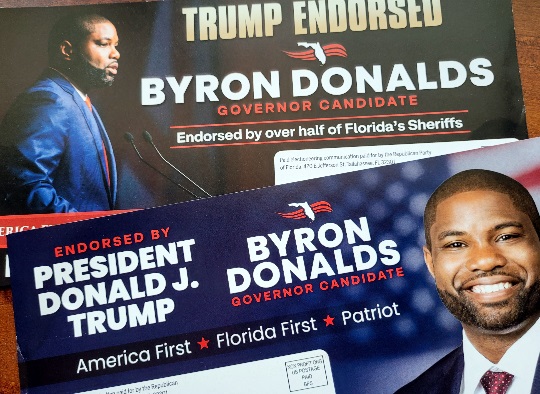
Direct mail items from Byron Donalds campaign; photo by Thursday Review
Florida Governor's Race Set:
Donalds Will Face Jolly
| published August 19, 2026 |
By R. Alan Clanton
Thursday Review editor
Though Florida is prone to become a noisy stage for Election Day surprises and the occasional home of shrill post-election drama, the outcomes of the Sunshine State’s arguably biggest primary race came as little surprise to anyone.
Florida congressman Byron Donalds easily defeated his GOP opponents—former Speaker of the House Paul Renner, current Lt. Governor Jay Collins, and businessman and activist James Fishback—in a lopsided win. With nearly 100% of the votes counted, Donalds appears to have secured some 48% of the total, pulling in almost twice the votes cast for Collins, and four times those votes cast for Fishback.
Renner—who had received warm praise from current Governor Ron DeSantis though DeSantis stopped short of an outright endorsement—garnered a disappointing 8.6% of the vote. Collins secured roughly 25% of the total GOP vote.
Donalds, who had early on received the endorsement of President Donald Trump, had been ahead in most polls for months, at times hovering between 45-to-50 percent despite aggressive advertising by Collins. Renner had attempted a last ditch effort to spark enthusiasm for his candidacy based on his conservative credentials and his close alignment to DeSantis major efforts to redefine Florida as an anti-woke state. But in the end neither Collins nor Renner were able to make much of a dent in Donalds’ wide lead.
Byron Donalds’ blowout win launches his campaign forward and, if successful in November, will make him the first African-American to reside in the Florida Governor’s mansion. Donalds pulled-in some 812,000 votes in the primary, a critical warning bell for Democrats who would like to reclaim the governor’s office after more than 25 years of Republican chief executives.
Democrat Byron Jolly handily defeated his primary opponents by winning 61% of the vote. His only significant rivals were Dayna Marie Foster and Dotie Joseph, who ended the day with 15% and 9.6% respectively.
So secure had Donalds’ lead been in recent weeks that his campaign strategists had already begun to turn their advertising efforts away from the primary and begin lobbing their heavy ordnance at Jolly. In Florida, most political analysts predict heavy spending by both candidates and both parties on the governor’s race.
In the media rooms and watch parties Tuesday night, it appeared most Florida Republicans are closing ranks behind Donalds; early polling indicates Donalds has a sturdy lead over Democrat Jolly, though the undecided voters remain significant.
Donalds’ substantial lead in the polls heading into late spring effectively allowed Donalds to avoid debating his Republican opponents, and his lead was so massive in July that even the Florida GOP saw no reason to organize or sponsor any debates—frustrating Collins, Renner, and Fishback. In addition, Collins had challenged Fishback’s eligibility to be included on the ballot since Fishback had bought a home in the District of Columbia and had voted in D.C. After several days of legal wrangling, a judge in Tallahassee concluded that Fishback’s name could remain on the ballot.
Fishback had generated criticism even from many Republicans for his use of racist language, his dubious business practices, and his close association with Nick Fuentes and other extremist online bloggers.
After his huge win, Donalds addressed large crowds and scores of reporters at an event in Orlando late Tuesday night. Donalds acknowledged the tough primary fight, asked for Republicans to unify behind his campaign, and said that it was time to move forward into an important General Election.
David Jolly—an anti-Trump Republican turned Independent turned Democrat—hopes to position himself as a centrist candidate who can reach across all party lines and defy political boundaries. Jolly hopes to capitalize on what he sees as vulnerabilities for the GOP because of Trump’s handling of the Iran War, rising gas prices and rising cost-of-living.
Still, the challenge for Jolly may be gargantuan: most political analysts see little reason for a sea change in Florida politics this time around.
Republicans have controlled the executive branch in Florida since Jeb Bush’s win in 1998, establishing a GOP stronghold in Tallahassee which has grown more solidly Republican with each passing election cycle. Donalds hopes to leverage that Red State atmosphere and coast to a comfortable win in November.
Jolly hopes to get Democrats to quickly coalesce behind his campaign, though the political challenge may be more complex than ever in Florida: among Tuesday’s surprise outcomes was Angie Nixon’s big win over her Democratic opponent Alex Vindman in the primary race for U.S. Senate. Nixon—an avowed Democratic Socialist and a member of the Florida House of Representatives from Jacksonville—is arguably the most progressive and leftward leaning candidate for the U.S. Senate the Sunshine State has ever produced.
Nixon will face off against Republican Ashley Moody in November. Moody had been chosen by Governor DeSantis to replace Marco Rubio after Rubio agreed to become President Trump’s Secretary of State.
Moody, too, leads in many polls, but most analysts suggest that the race between Nixon and Moody could become very close. The race will also pit two highly contrasting political portraits against one another: Moody, a lawyer and former Attorney General, is a longtime Trump supporter who, when running for Attorney General in 2022, buried her opponent in a heavily lopsided victory.
Nixon, who has co-authored award-winning children’s books, owned a coffee-smoothie-candy shop and a bookstore, organized labor groups, and has been notably anti-Israel in some of her legislative proposals, was famously tossed from the House floor after using a bullhorn to disrupt a legislative session when the GOP-controlled room was working on redistricting. She was also arrested in May after a sit-in in DeSantis' office in a protest over congressional redistricting.
Nixon’s win over Vindman was seen as a shocker, but nevertheless in keeping with other Democratic Socialist victories in other parts of the country during the past 12 months.
Oddly enough, in the governor’s race there is already consensus on some top issues: both Republican Donalds and Democrat Jolly have said that affordability should be one of the top priorities of the next administration, and both have also said that improvement in wages is also a key goal. Most polling indicates that Florida voters worry most about wages and cost of living.
Close watchers of primary results have also noted the math at work: in the GOP Primary race, some 1.7 million votes were cast in total; in the Democratic race, roughly 1.25 million votes were cast. This disparity shows not merely the historical tendency of Republican voters to participate more deeply in primaries and elections, compared to a Democratic voter tendency in some elections to stay home. This gap may also be a warning to the Florida Democratic Party that the GOP has better outreach to voters and a more comprehensive understanding of the political landscape. Jolly must motivate voters to go to the polls, and he will not be able to simply leverage an anti-Trump position to accomplish this daunting task.
Donalds has another significant advantage over Jolly: a war chest some ten times as large, with at least $100 million on hand for advertising and campaign expenses, compared to Jolly’s $10 million, according to CBS News. This is a sure indication that Floridians will soon be bombarded with direct mail and television advertising as both candidates attempt to spend their way toward victory on Election Day.
Related Thursday Review articles:
Byron Donalds and Florida's "No Debate" Debate; By R. Alan Clanton, Thursday Review editor; July 30, 2026.
A Political Autopsy With Few Surprises; By R. Alan Clanton, Thursday Review editor; May 24, 2026.